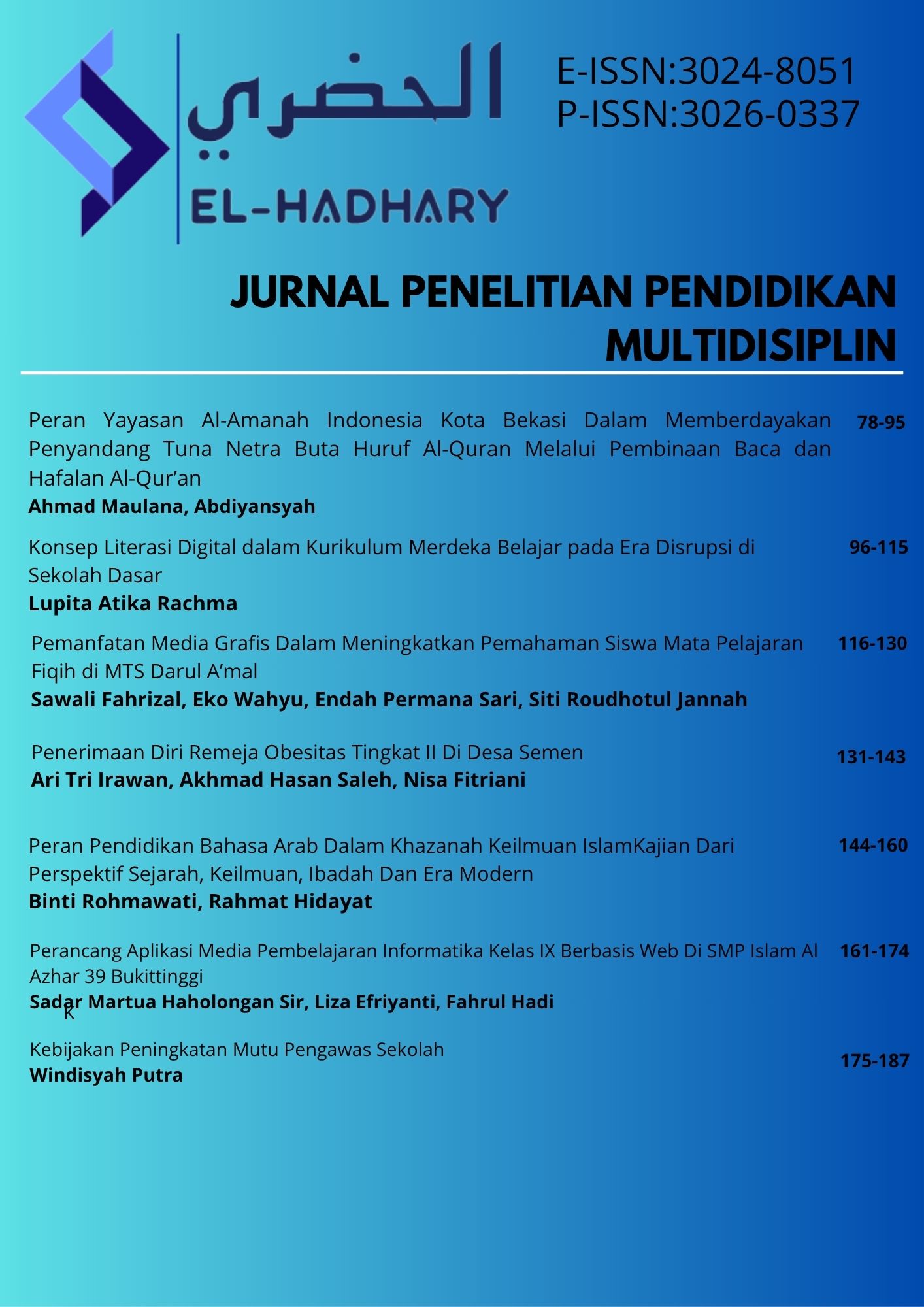
The Concept of Digital Literacy in the Independent Learning Curriculum in the Era of Disruption in Elementary Schools (Book Review "Digital Literacy in the World of Education in the 21st Century" by Daniel Ginting)
Kajian Buku “Literasi Digital dalam Dunia Pendidikan di Abad ke-21” Karya Daniel Ginting
DOI:
https://doi.org/10.61693/elhadhary.vol302.2025.96-115Keywords:
Digital Literacy, Independent Learning Curriculum, Era of Disruption, Elementary School, Book StudyAbstract
The era of disruption is marked by the rapid development of ICT, education is required to adapt through a change in mindset from a fixed mindset to a growth mindset in order to create effective, efficient, and relevant learning. The use of ICT in schools, such as e-report cards and digital-based learning has become a necessity in line with the demands of generation Z and alpha who are growing up in a digital environment. However, major challenges are still faced, especially the low digital literacy of teachers and students which has an impact on the quality of learning. Digital literacy, which includes technical skills, critical thinking, and responsible use of digital media, needs to be strengthened through training and integration in the independent curriculum. The book "Digital Literacy in the World of Education in the 21st Century" by Daniel Ginting et al. is an important foundation in understanding digital literacy strategies in elementary schools that involve access, analysis, evaluation, creation, and participation in digital media. Therefore, this study aims to find out the concept of digital literacy in the independent learning curriculum in the era of disruption in elementary schools to study the book "Digital Literacy in the World of Education in the 21st Century" by Daniel Ginting et al., to find out the criteria, types, and functions of digital literacy in the independent learning curriculum in elementary schools, and to find out the content of learning materials in the independent learning curriculum in elementary schools that can be integrated with literacy digital. This study uses a qualitative library research method with a qualitative content analysis approach influenced by the naturalistic-interpretive paradigm. The two sources of research data obtained, namely primary data sources in the form of the thoughts of figures and works by Daniel Ginting et al. as authors of the book "Digital Literacy in the World of Education in the 21st Century" in 2021 and secondary data sources in the form of the book "Digital Literacy and Mobile Learning" by Usman et al. and the book "Digital Literacy in Education: Integration and Innovation" by Ganjar Winata Martoatmodjo et al. The research uses documentation data collection techniques and qualitative content analysis techniques used in this study are discourse analysis techniques. The results of the study show that the book by Daniel Ginting et al. entitled "Digital Literacy in the World of Education in the 21st Century" contains the concept of digital literacy which includes five main competencies, namely access, analysis, evaluation, creation, and participation in the use of digital technology. Digital literacy in the independent learning curriculum functions not only as a technical skill, but also as a foundation in forming critical, collaborative, creative, and responsible thinking skills in the use of digital technology. This study also found that elementary school subjects that have implemented an independent learning curriculum from grades 1-6, such as Indonesian, PPKn, English, Science, Social Studies, SBdP, Mathematics, and the P5 project are very relevant to be integrated with digital literacy. Thus, digital literacy can be a key element in supporting learning transformation that is adaptive to technological developments and the needs of the times.
Keywords: Digital Literacy, Independent Learning Curriculum, Era of Disruption, Elementary School, Book Study
Downloads
References
Ahmad, Jumal. (2018). Desain Penelitian Analisis Isi (Content Analysis). Skripsi Pascasarjana. UIN Syarif Hidayatullah.
Belshaw, Doug. (2011). The Essential Elements of Digital Literacies. Doctoral Thesis. Durham University.
Cecep & Anang Rohmanudin. (2022). Implementasi Kurikulum Merdeka dalam Meningkatkan Kreativitas Siswa di Sekolah Dasar. JPE: Jurnal Primary Edu, 2(1), 22.
Cheek, Julianne. (2004). At the Margins? Discourse Analysis and Qualitative Research. Sage Journals, 14(8).
Cynthia, Riries Ernie & Hotmaulina Sihotang. (2023). Melangkah Bersama di Era Digital: Pentingnya Literasi Digital untuk Meningktakan Kemampuan Berpikir Kritis dan Kemampuan Pemecahan Maslah Peserta Didik. Jurnal Pendidikan Tambusai, 7(3), 31714.
Diputra, Komang Sujendra, Ni Ketut Desia Tristiantari, et al. (2020). Gerakan Literasi Digital bagi Guru-Guru Sekolah Dasar. Journal of Character Education Society, 3(1), 118.
Feriyanto. (2022). Strategi Penguatan Literasi Numerasi Matematika bagi Peserta Didik pada Kurikulum Merdeka Belajar. Jurnal Gammath, 7(2), 86-87.
Gilster, Paul & Watson T. (1997). An Excerpt from Digital Literacy. Digital Literacy.
Ginting, Daniel, Fahmi, et al. (2021). Literasi Digital dalam Dunia Pendidikan di Abad ke-21. Malang: Media Nusa Creative.
Ginting, Rahmanita. (2020). Kemampuan Literasi Media pada Era Informasi Digital di Kalangan Mahasiswa Kota Medan. TALENTA Conference Series: Local Wisdom, Social, and Arts, 3(1), 98 & 100.
Hamson, Zulkarnain, Hasrullah, et al. (2024). Literasi Media Digital di Indonesia. Serang: CV. Cermindo Utama.
Heryani, Ani, Nurul Pebriyanti, et al. (2022). Peran Media Pembelajaran Berbasis Teknologi dalam Meningkatkan Literasi Digital pada Pembelajaran IPS di SD Kelas Tinggi. Jurnal Pendidikan, 31(1), 23.
Hussin, Anealka Aziz. (2018). Education 4.0 Made Simple: Ideas for Teaching. International Journal of Education and Literacy Studies, 6(3), 92.
Johnston, Nicole. (2020). The Shift Towards Digital Literacy in Australian University Libraries: Developing a Digital Literacy Framework. Journal of the Australian Library and Information Association, 69(1), 93-101.
Kholid. (2020). Pentingnya Literasi Digital bagi Guru pada Lembaga Pendidikan Tingkat Dasar dan Implikasinya Terhadap Penyelenggaraan Kegiatan Belajar Mengajar. Jurnal Horizon Pedagogia, 1(1), 23-27.
Maharani, Ladiva Shyafa Putri, Siti Istiyati, et al. (2024). Analisis Keterampilan Literasi Digital Peserta Didik melalui Penggunaan E-Learning Sekolahku di Sekolah Dasar. Didaktika Dwija Indria, 12(2), 100-110.
Martoatmodjo, Ganjar Winata, Irna Sjafei, et al. (2024). Literasi Digital dalam Pendidikan: Integrasi dan Inovasi. Purbalingga: Eureka Media Aksara.
Nurmayani. (2023). Minat Membaca Siswa Kelas V Sekolah Dasar Sekota Palopo di Era Society 5.0. Skripsi Sarjana. IAIN Palopo.
Rahmadani, Tunjung Tamarin. (2025). Pembelajaran Berbasis Teknologi sebagai Penguatan Literasi Digital Peserta Didik Kelas V SD Supriyadi Semarang. BADA’A: Jurnal Ilmiah Pendidikan Dasar, 6(2), 763-770.
Resti, Rizka Annisa Wati, et al. (2024). Pemanfaatan Media Pembelajaran Berbasis Teknologi sebagai Alat untuk Meningkatkan Kemampuan Literasi Digital Siswa Sekolah Dasar. Al-Madrasah: Jurnal Ilmiah Pendidikan Madrasah Ibtidaiyah, 8(3), 1153.
Rosyadi, Faiq Ilham, Aswatun Hasanah, et al. (2020). Pola Pendidikan di Era Disrupsi. Yogyakarta: Timur Barat.
Safitri, Ida, Sufyarma Marsidin, et al. (2020). Analisis Kebijakan terkait Kebijakan Literasi Digital di Sekolah Dasar. Edukatif: Jurnal Ilmu Pendidikan, 2(2), 177-178.
Sawitri, Erwin, Made Sumiati Astiti, et al. (2019). Hambatan dan Tantangan Pembelajaran Berbasis Teknologi Informasi dan Komunikasi. Palembang, Indonesia: Pendidikan Program Pascasarjana, Universitas PGRI.
Sitasari, Novendawati Wahyu. (2022). Mengenal Analisa konten dan Analisa Tematik dalam Penelitian Kualitatif. Forum Ilmiah, 19(1), 79-80.
Susetyo. (2020). Permasalahan Implementasi Kurikulum Merdeka Belajar Program Studi Pendidikan Bahasa Indonesia FKIP Universitas Bengkulu. Jurnal FKIP Universitas Bengkulu, 7(1), 29-43.
Tsaniyah, Naimatus & Kannisa Ayu Juliana. (2019). Literasi Digital sebagai Upaya Menangkal Hoaks di Era Disrupsi. Al-Balagh: Jurnal Dakwah dan Komunikasi, 4(1), 122.
Usman, Zulfah, et al. (2022). Literasi Digital dan Mobile Learning. Parepare: IAIN Parepare Nusantara Press (Anggota IKAPI).
Usmeldi, Risda Amini, et al. (2023). Pelatihan Pembuatan E-Modul Interaktif berbasis Teknologi Informasi untuk Meningkatkan Literasi Digital Guru SD dan SMP di Kapau Kabupaten Agam. Jurnal Pengabdian Pada Masyarakat, 8(3), 616.
Yuniarto, Bambang & Rivo Panji Yudha. (2021). Literasi Digital sebagai Penguatan Pandidikan Karakter menuju Era Society 5.0. Jurnal Edueksos, 10(2), 181-189.
Downloads
Published
How to Cite
Issue
Section
License
Copyright (c) 2025 Lupita Atika Rachma

This work is licensed under a Creative Commons Attribution-ShareAlike 4.0 International License.